

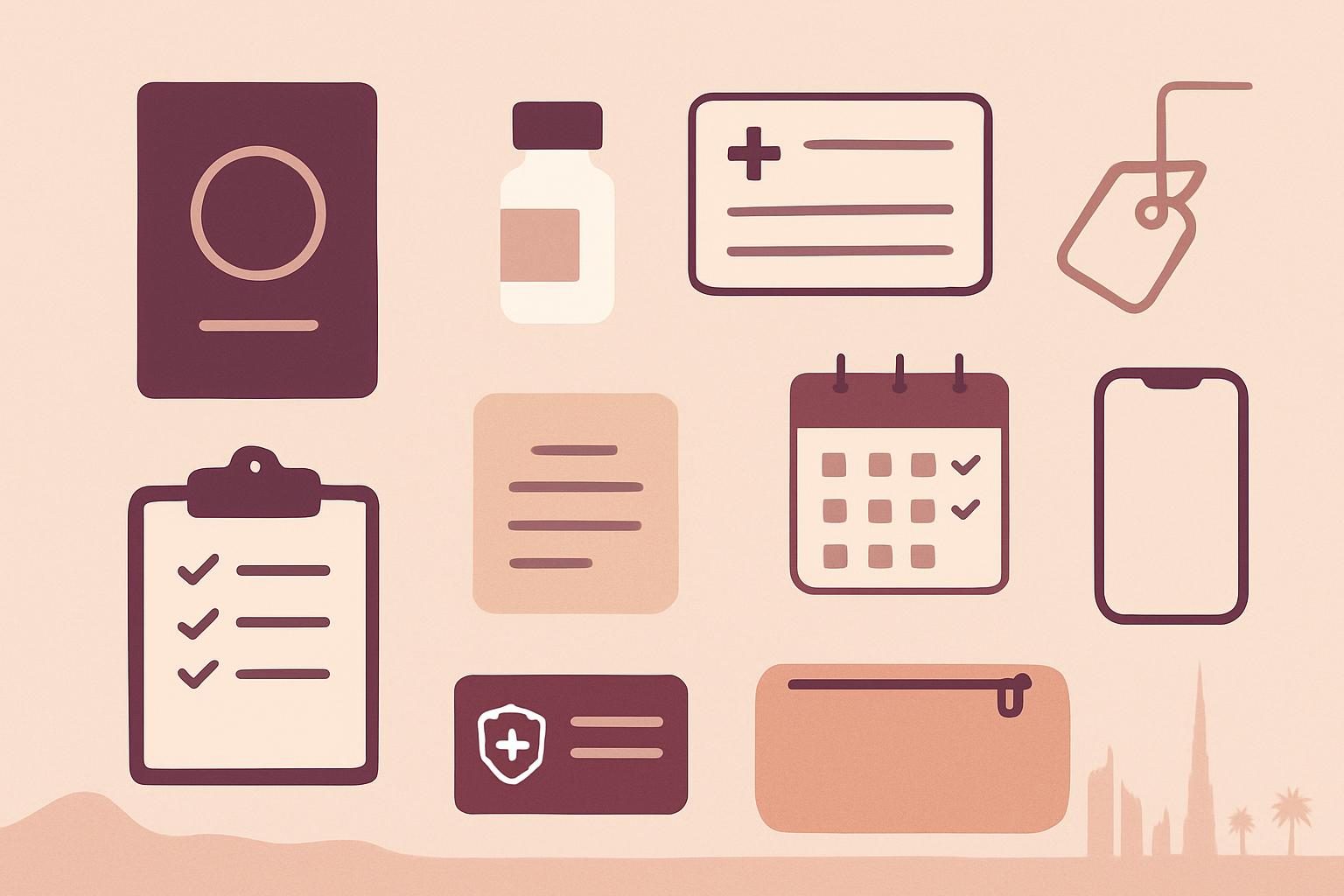
Do not pack essential medication in the shipping container
If you are moving to Dubai, medication should be part of your pre-move plan, not something you sort out after arrival. The safest approach is to carry essential medicines with you, keep your medical records together, and confirm local availability and any import rules before you fly. That matters whether you are using an employment visa, self-employed visa or another Dubai visa route.
Direct answer: Before moving to Dubai, create a medication pack with your current prescription, a medical summary, enough travel supply, insurance details and a checked list of what can be brought into the UAE. Then use the first 30 days in Dubai to replace any items you cannot carry long term and to register with a local doctor if needed.
Medication before Dubai: the checklist
1. List every medicine you take regularly
Start with a plain list of all prescription medicines, over-the-counter medicines you use often, inhalers, injections, supplements and any devices such as glucose testing items or allergy treatments. Note the generic name if you know it, not just the brand name, because brands can change between countries.
- Daily prescription medicines
- Emergency or rescue medicines
- Repeat medicines that may run out soon after arrival
- Any medicines for children or a dependent family member
- Anything that needs refrigeration, sharps or special storage
2. Ask for a current medical summary
Request a concise medical summary from your doctor or clinic. Keep it simple and useful. It should explain your diagnosis, current medicines, dosage, why the medicine is needed and any known allergies. If you are moving to Dubai with family, prepare one summary per person who needs regular medication.
This is especially useful if you are changing doctors, starting a new job, or moving before your Emirates ID is issued and you are still settling your residency paperwork.
3. Carry your original prescriptions and evidence of use
Do not rely on a photo in your phone alone. Keep prescription copies, clinic letters and any supporting documents in your hand luggage. If a medicine is controlled, restricted or unusual, confirm current UAE rules with your doctor, pharmacist, airline and the relevant UAE authority before travel. Rules can change, so do not assume the same medicine is treated the same way everywhere.
| What to bring | Why it matters | When to prepare it |
|---|---|---|
| Current prescription | Helps explain what the medicine is and why you need it | Before departure |
| Medical summary | Useful for local doctors and insurance claims | Before departure |
| Original packaging | Makes identification easier during travel and checks | Before departure |
| Travel supply | Reduces risk if your local replacement is delayed | Before departure |
| Insurance details | Supports early clinic visits and medicine planning | Before departure |
4. Do not put the only supply in shipment storage
This is the mistake that causes avoidable stress. Shipping containers can be delayed, customs checks can slow things down and temperature-sensitive medicines may not travel well with household goods. Keep the medicine you will need in the first weeks with you in hand luggage or another bag that travels with you directly.
If you are moving with family, make the same decision for children’s medicines, including fever treatment, allergy medicines and any regular treatments. Do not let family travel bags and shipping logistics become the reason something important is inaccessible.
5. Check whether your medicine is available in Dubai
Before you move, ask your doctor or pharmacist whether there is a common equivalent, a different brand name or a suitable alternative available in the UAE. This is one of the most practical steps in any Dubai move plan because local availability can affect what you need to carry, how much you need to bring and how quickly you need a clinic appointment after arrival.
If the medicine is routine and easy to replace, you may only need a short travel buffer. If it is specialist, costly, or time-sensitive, you need a clearer backup plan and a local doctor contact.
6. Put insurance details in one place
Keep your medical insurance policy details, membership number and any pre-authorisation instructions together with your records. If you are changing jobs, moving on a self-employed route or arriving before coverage is active, know exactly when your policy starts and what it covers. Do not assume every consultation, test or pharmacy item will be handled the same way.
This is also where your wider Dubai relocation plan matters. Your visa route affects timing, your employment status affects insurance, and your arrival date affects how quickly you can deal with any medication gap.
7. Build a travel buffer, not a guess
Bring enough medication to cover the period between arrival and your first realistic local refill. That buffer should reflect your route, your paperwork timing and whether you already know a local doctor or pharmacy. It should not be based on hope that everything will be sorted within a day or two.
For a single professional on an employment visa, the buffer might be modest if their records are complete and their employer support is organised. For a family move, or for anyone with specialist treatment, the buffer should be more conservative.
How this fits the first 30 days in Dubai
Healthcare planning belongs ahead of banking, DEWA and internet setup. In a practical first-month sequence, medication and records come first, because you may need them before your residency paperwork, bank account or tenancy steps are complete. Use the first 30 days in Dubai checklist to place healthcare preparation where it belongs in the move timeline.
A useful order is: carry medication, secure your documents, confirm local availability, review insurance, then handle your residency and practical setup. That keeps you from treating medicine as an afterthought while you are busy comparing rent, bank account steps and utilities.
A simple example
Imagine a couple moving from the UK on an employment visa with one child who uses regular asthma treatment. They should not ship the child’s inhalers with the rest of the furniture and hope they arrive on time. Instead, they should carry the current supply, keep a doctor summary and prescription copies together, ask whether the same inhaler or a local equivalent is available in Dubai, and keep the insurance details ready in case a clinic visit is needed in the first week.
Use this medication preparation sequence
- Make a complete medicine list for each person.
- Ask for prescriptions and a short medical summary.
- Check whether the medicine is allowed, restricted or needs extra confirmation in the UAE.
- Confirm local availability by brand or generic name.
- Pack the first weeks supply in hand luggage.
- Store insurance details and emergency contacts together.
- Plan a local doctor or clinic visit if you need one soon after arrival.
If you are still mapping the rest of the move, it can help to review the main Dubai visa routes for new movers alongside your health plan, because visa timing and residency setup can affect what you can do next.
What to confirm before you travel
- Whether any of your medicines have special import rules
- Whether you need a doctor letter or translation
- How much medicine you can realistically carry for personal use
- Whether your insurance starts before or after arrival
- Whether a local pharmacy can supply the same brand or a safe equivalent
- Whether a specialist appointment should be booked soon after you land
The point is not to overcomplicate the move. It is to avoid finding out on day three that an essential medicine is in the shipping container, the prescription is not enough on its own, or the local replacement is not as simple as expected.
FAQ
Can I bring prescription medication when moving to Dubai?
Often yes, but the exact rules can depend on the medicine, quantity and whether it is restricted or controlled. Keep it in original packaging, carry the prescription and check current UAE guidance before travelling. If in doubt, confirm with your doctor, pharmacist, airline and the relevant official source.
Should I pack medicine in checked luggage or hand luggage for Dubai?
For essential medication, hand luggage is usually the safer choice because it stays with you. That reduces the risk of delay, loss or temperature problems during shipping. If a medicine needs refrigeration or special handling, ask your pharmacist how to travel with it properly before you fly.
What medical records do I need before moving to Dubai?
Bring a short medical summary, current prescriptions, allergy information and any documents that explain ongoing treatment. If you are moving with family, keep each person’s records separate and easy to access. This helps local doctors, pharmacies and insurance processes after arrival.
How do I check if my medicine is available in Dubai?
Ask your doctor or pharmacist for the generic name and common equivalent brands, then confirm with a local pharmacy or clinic once you know where you will live. Availability can change, so do not rely on old forum posts or assumptions from another country.
Do Dubai visa routes affect medication planning?
Yes, because visa timing can affect residency steps, insurance activation and how quickly you can settle into local healthcare. An employment visa, self-employed visa or family move may each create a different timing pattern. Confirm the practical sequence before you travel so you are not relying on last-minute arrangements.
When should I use the first 30 days in Dubai checklist?
Use it as soon as your travel dates are fixed, because healthcare, residency and practical setup are connected. It is a good planning reference if you are trying to line up medication, insurance, Emirates ID timing and the rest of your first-month tasks in a sensible order.
If you want to turn the next steps into a clearer relocation checklist, Start Your Dubai Move Plan.